23 July 2026
Lincoln Aviator Recall 26V451: What Used Buyers Must Verify After 25S67
Car Buying

Ford’s July filing identifies 160,391 potentially involved Aviators and changes the remedy from the 2025 inspection to replacement of the switch bezel and housing with revised components. A completed 25S67 record does not establish the current 26S52 status of the same VIN.
Ford filed recall 26V451 with NHTSA on July 14, 2026, covering 160,391 Lincoln Aviators from the 2020 through 2027 model years — a larger group than the campaign it expands, with a different repair. For anyone shopping a used or Certified Pre-Owned Aviator that creates a documentation problem, not a reason to strike the model off the list. A history entry reading “recall performed” is no longer sufficient on its own, because the question is which campaign it names. Ford’s number for the new action is 26S52; the 2025 one was 25S67. Establish whether 26S52 applies to the specific VIN, whether it is still open, and whether a Ford or Lincoln retailer can produce a dated record for it. If nobody can answer that before money moves, make the transaction conditional on it. A buyer expecting regular second-row passenger use may reasonably hold to a stricter threshold and wait for documented completion. None of this settles whether the Aviator is a good used car — it settles one gate.
Contents
- Why the Aviator remains on the shortlist
- What Ford told NHTSA in July
- From inspection to replacement
- Why a completed 25S67 does not answer the 26S52 question
- Notification dates are not repair dates
- What to ask for, and in what order
- Where Certified Pre-Owned helps, and where it stops
- Buyer calls by what the paperwork shows
- What is still unknown
- Frequently Asked Questions
Reference
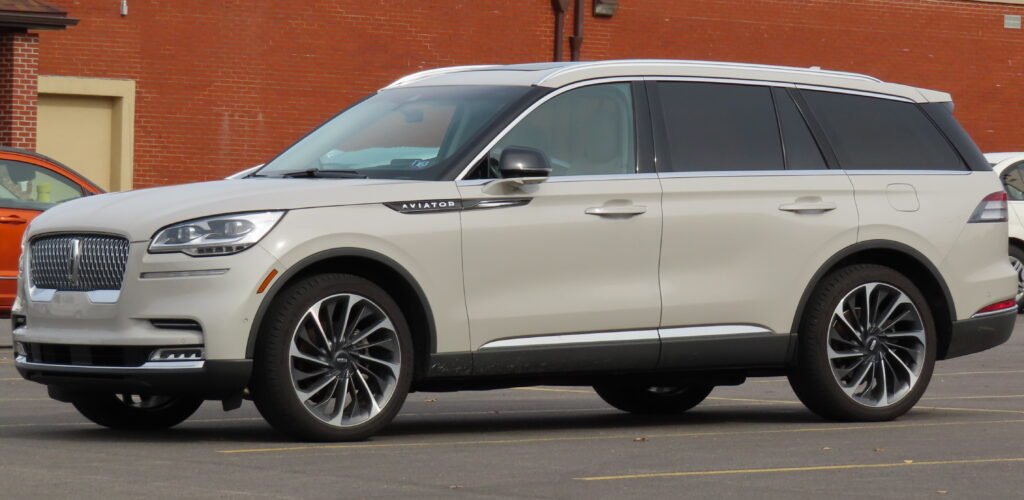
Why the Aviator remains on the shortlist
The Aviator combines three-row packaging with Lincoln’s premium positioning, which is enough to explain why a used buyer may want to resolve the campaign record rather than reject every vehicle by model year. The recall does not erase the appeal. It changes the evidence required before that appeal becomes a purchase.
What Ford told NHTSA in July
The filing covers 387,911 vehicles across two models. The Aviator share is 160,391; the remaining 227,520 are Ford Explorers. Aviator applicability spans the 2020 through 2027 model years, built between October 19, 2018 and June 24, 2026 — production dates, which do not map onto model years. Ford states the affected vehicles were not produced in VIN order and sends vehicle-specific questions to a Ford or Lincoln retailer, who can check the car in Ford’s OASIS service database. A model-year range is not a list of affected cars.
The condition sits in the second-row outboard easy-entry switch — the control that tips and slides the seat forward for third-row access. Ford describes it as capable of intermittently binding or sticking in the down position, which may result in the seat tipping or sliding unexpectedly, potentially while driving, and states the consequence as an increased risk of injury, particularly in a crash. The specific root cause remains under investigation.
Two boundaries matter here. Ford told NHTSA it was not aware of reports of accidents or injuries related to this condition at the time of filing, and neither consumer-advisory box — Do Not Drive, Park Outside — is marked. As of June 16, 2026, Ford had identified fourteen reports of unintended second-row seat movement while driving on vehicles in the new action: eight on North American vehicles outside the earlier campaign, six on cars already remedied under it. Those counts cover Explorers and Aviators together and are report counts, not an incident rate. They cannot be added to the roughly one hundred reports in the 2025 filing, which used a different cutoff, population and stage of investigation.
From inspection to replacement
The June 2025 campaign and the July 2026 campaign describe the same symptom and treat it very differently.
| Field | 25V393 / 25S67 | 26V451 / 26S52 | What it means for a buyer |
|---|---|---|---|
| Filed with NHTSA | June 13, 2025 | July 14, 2026 | Two campaigns, two records. |
| Aviator model years | 2020–2025 | 2020–2027 | The newer action reaches later cars. |
| Potentially involved Aviators | 121,235 | 160,391 | About 39,000 more Aviators. |
| Aviator production window | Oct 19, 2018 – Nov 4, 2024 | Oct 19, 2018 – Jun 24, 2026 | The original bezel stayed in production to the later date. |
| Part 573 estimated percentage with defect | 6% | 100% | Ford’s filing estimate for each recalled population — not a malfunction rate or incident rate. |
| Remedy type | Inspect | Replace | Different work, different repair order. |
| What the retailer does | Inspect the bezel for correct installation, replace if damaged or missing, confirm the switch operates | Replace bezel and housing with a revised design, at no charge | A 2025 visit may have ended with no parts fitted. |
| Stated cause | Bezel misaligned by incorrect installation at the seat supplier | Root cause under investigation; bezels may become misaligned or unseated during customer use | — |
| Consumer advisories marked | None | None | Neither filing tells owners to stop driving or park outside. |
| Planned remedy-owner notification | Aug 25–29, 2025 | Jan 5–8, 2027 | A mailing window, not a repair date. |
Why a completed 25S67 does not answer the 26S52 question
The decisive change is in how Ford now describes the cause.
In 2025 the explanation was bounded: a trim bezel had been installed incorrectly at the seat supplier, and the misalignment could interfere with the switch button. Dealers were told to check the seating and replace the bezel only if it was damaged or missing. The 2026 filing no longer treats incorrect installation as a complete explanation for the expanded action. It records that vehicles built after the earlier population had proper bezel seating verified by the seat supplier and at the assembly plant, that vehicles repaired under the earlier campaign had proper seating verified by dealers, and that a re-reviewed tolerance stack-up analysis confirmed a correctly installed bezel will not interfere with button operation. It then adds that bezels may become misaligned or unseated during customer usage, citing field return parts and warranty claims, some of which record broken bezel tabs.
So the question is no longer only whether the part was fitted correctly. It is whether it stays fitted — which is why the new remedy replaces bezel and housing with a revised design, and why Ford says the replacement bezel will have a higher retention force than the recalled one.
A correctly performed 2025 inspection is therefore not evidence against the new campaign. It is evidence that the car passed a check the new campaign no longer treats as sufficient. The 26S52 population takes in both the original vehicles and those built through June 24, 2026, when the original bezel left production. The six reports involving previously remedied vehicles are not a finding that the earlier remedy failed universally, and the filing does not identify them as Aviators, as crashes, or as independently confirmed events. They do establish why a completed 25S67 record cannot, by itself, close the 26S52 question. Applicability remains VIN-defined, and a current owner should check the VIN and follow the current instructions provided by Ford or a Ford or Lincoln retailer.
Notification dates are not repair dates
The filing sets dealer notification for July 16, 2026, and the same date for the VINs to become searchable. Interim owner letters were scheduled for late July 2026 — the narrative and the structured schedule fields disagree on the closing day, so the narrower reading is the safer one. A second notification, telling owners the remedy is available, is planned for January 5 to 8, 2027.
That January window is a mailing date, not a repair date. It does not establish that no retailer can do the work before then, and the record equally does not establish that revised parts are on shelves now. Ford’s filing defines the remedy; it does not report parts or appointment availability, and no public document that does was located. Only a retailer can resolve that for a specific VIN.
What to ask for, and in what order
Start with the VIN through NHTSA’s recall lookup and Lincoln’s recall and field service action page. NHTSA’s tool displays unrepaired recalls, and where none is found it returns “0 unrepaired recalls associated with this VIN.” That result is not a complete campaign history: repaired recalls are omitted, and some recently announced recalls may not appear until all affected VINs have been identified. This differs from FSC’s BMW 26V441 case, where the buyer was waiting for a future VIN-search date. Here the VINs are already searchable and the task is separating two campaign records.
Use both lookups to screen the vehicle, then put four questions to the retailer, in writing: does 26S52 apply to this VIN; is it currently open; is a remedy available for it; can an appointment be scheduled.
The clearest completion evidence is a dated, VIN-specific repair order that identifies 26S52 and records the revised bezel-and-housing remedy as completed. A campaign number on its own does not show completion — it can appear on a diagnosis, a parts order or an open record. A retailer status statement should likewise say whether the campaign is applicable, open or closed for that VIN. A record documenting completion of 25S67 establishes only the earlier campaign. Recall status is not a condition report either, so an independent pre-purchase inspection stays a separate step, alongside the rest of the documentation a premium used purchase should produce before signing.
Where Certified Pre-Owned helps, and where it stops
Lincoln’s certification process engages with recalls directly. Both inspection checklists — Signature and Select — open with a Vehicle History section whose first line is “Service Recalls (OASIS) Performed,” followed by a free-text field reading “List Any Open Recall(s) – FSA # and Description.”
Those forms show that recall status is part of Lincoln’s VIN-specific certification workflow. A blank template does not show what was recorded for a particular vehicle; only the completed checklist does. FSC could not locate a public controlling Lincoln document stating whether an open 26S52 blocks or permits certification, advertising, sale reporting, customer delivery or warranty activation. The absence of a public rule is not evidence that no internal policy exists.
For a Certified Pre-Owned Aviator, ask for the completed checklist, the certification tier and date, the open-recall entry and a dated 26S52 status record. Both forms contain three signature fields and designate a copy for the buyer — Signature assigns Copy 2 to the client, Select assigns the original to the owner — but the checklist should not be treated as proof of campaign completion unless the completed document and a supporting repair record say so. Both checklists also include a folding-seat functional check; that inspection and a campaign-completion record answer different questions, and only the latter establishes the documented status of 26S52.
Select-tier buyers should additionally get the warranty start and end dates in writing, because Lincoln’s public Certified Pre-Owned pages describe the Select start point inconsistently.
Buyer calls by what the paperwork shows
The recall-specific call depends on what can be documented for that VIN. Ordinary due diligence sits alongside each of these, not inside them.
- Ford, Lincoln or an OASIS-based retailer check confirms the VIN is not included in 26S52. The recall-specific gate is clear, subject to ordinary used-car due diligence.
- 25S67 was completed, but 26S52 status is unknown. Recheck before deciding. The earlier completion record leaves the current campaign unresolved.
- 26S52 applies and remains open, while remedy availability is undocumented. Wait, or make the transaction expressly conditional on a dated status update and a defined repair path. A buyer expecting regular second-row passenger use may reasonably choose the stricter WAIT threshold.
- A retailer documents completion of 26S52 under the revised bezel-and-housing remedy. The recall-specific gate is clear, subject to an independent pre-purchase inspection and the rest of the ownership review.
- A Certified Pre-Owned listing lacks campaign-specific documentation. Proceed only with conditions: obtain the completed checklist, certification tier and date, the open-recall entry and a dated 26S52 status or completion record.
- Current owner. Check the VIN through Lincoln and NHTSA, contact a Ford or Lincoln retailer, and follow the current instructions Ford provides for your vehicle. There is no owner-side workaround in the public record, and none should be improvised.
What is still unknown
As of July 23, 2026, FSC did not locate an additional public 26V451 or 26S52 document in NHTSA’s record in this pass beyond the Part 573 filing. No acknowledgment letter, owner letter, dealer communication or remedy instruction was identified during that search. Several things also remain unestablished and should not be assumed in either direction: current parts availability; whether an appointment can now be scheduled for a given VIN; the repair procedure and labor operation; the revised bezel and housing part numbers, which are not in the filing — LB5B-S67460-BD is the recalled bezel, not its replacement; any public Lincoln policy specific to 26S52; and how affected cars are being listed and priced.
Frequently Asked Questions
My Aviator already had the 2025 recall performed. Do I need to do anything now?
Check the VIN against the new campaign rather than assuming either outcome. Vehicles repaired under 25S67 sit inside the 26S52 population, and the expanded action was approved partly because previously remedied cars appeared in Ford’s field data. Applicability is VIN-defined, so confirm status with Lincoln or a Ford or Lincoln retailer and follow the current instructions Ford provides for your vehicle.
Is it illegal for a dealer to sell me a used Aviator with an open recall?
That cannot be answered nationwide from 49 U.S.C. § 30120(i) alone. The remedy-before-delivery rule in that subsection applies to notified new vehicles in dealer inventory and to covered rental-company vehicles; it does not create a blanket federal rule for ordinary used or Certified Pre-Owned retail sales, and it states expressly that offering a vehicle for sale is not prohibited. State law, dealer obligations and CPO program rules may add separate requirements. This is a general description, not legal advice. Whatever the sale boundary, the buyer still needs VIN-specific campaign status and matching completion evidence.
Does a vehicle history report settle whether the recall is done?
No. A CARFAX report can flag an open recall, and CARFAX states that only unfixed recalls appear on a Vehicle History Report. That is the same limitation the NHTSA lookup carries: a report with no 26S52 entry cannot distinguish a vehicle that was never included from one that was included and has since been repaired. CARFAX also states that its products are based only on information supplied to it and that it does not have the complete history of every vehicle. Use the report to screen, then verify the VIN through NHTSA and Lincoln and obtain dated, VIN-specific documentation of the current 26S52 status.
Sources Checked
- NHTSA, Part 573 Safety Recall Report 26V451 (Ford Motor Company), submitted July 14, 2026 — https://static.nhtsa.gov/odi/rcl/2026/RCLRPT-26V451-5134.pdf
- NHTSA, Part 573 Safety Recall Report 25V393 (Ford Motor Company), submitted June 13, 2025 — https://static.nhtsa.gov/odi/rcl/2025/RCLRPT-25V393-7723.pdf
- NHTSA, Recall Acknowledgement Letter 25V393, dated June 17, 2025 — https://static.nhtsa.gov/odi/rcl/2025/RCAK-25V393-0612.pdf
- NHTSA, “Check for Recalls” VIN-lookup guidance — https://www.nhtsa.gov/recalls
- Lincoln, Recalls and Field Service Actions (official VIN lookup) — https://www.lincoln.com/support/recalls/
- Lincoln, Certified Pre-Owned Additional Benefits — https://www.lincoln.com/certified-used/about-certified/additional-benefits/
- Lincoln, Certified Pre-Owned Frequently Asked Questions — https://www.lincoln.com/certified-used/about-certified/faq/
- Lincoln, Signature Certification 200-Point Vehicle Inspection Checklist — https://www.lincoln.com/acslibs/content/dam/na/lincoln/en_us/images/services/certified-pre-owned/pdfs/LCPO01100_LIN_Signature_InspectionChecklist_R02.pdf
- Lincoln, Select Certification 139-Point Vehicle Inspection Checklist — https://www.lincoln.com/acslibs/content/dam/na/lincoln/en_us/images/services/certified-pre-owned/pdfs/LCPO01100_LIN_Select_InspectionCheck_R03.pdf
- CARFAX, Recall Tracker (report contents and coverage disclaimer) — https://www.carfax.com/recall-tracker
- 49 U.S.C. § 30120, Remedies for defects and noncompliance — https://www.govinfo.gov/link/uscode/49/30120
Limitations
FSC did not inspect, drive, repair, diagnose or examine an affected vehicle, and has no manufacturer or retailer access. This is a document-based analysis of United States public filings and official program material, covering one recall sequence — not the Aviator’s reliability, running costs, crash performance or value.
No robust current sample of used or Certified Pre-Owned listings was used, so nothing here describes how affected cars are being advertised, disclosed or priced. Public dealer, technician and owner reporting was too thin to establish anything about practical repair friction in either direction, and its absence proves nothing. Current remedy availability requires VIN-level confirmation, and Lincoln’s certification policy toward an open 26S52 was not located in public material and should not be inferred.
Last Updated
July 23, 2026.