Cadillac VISTIQ Recall 26V394: What the Third-Row Seat Disable Means for Owners and Buyers
Car Buying
Last Updated:July 12, 2026.
GM’s U.S. recall covers 14,540 model-year 2026–2027 Cadillac VISTIQ SUVs built within the production ranges identified in its NHTSA filing. On those cars, the third-row power-folding seatback can close on a small occupant without reversing. The remedy comes in two stages — an interim disable of the power-fold now, a replacement seat module later — so the practical questions are which VIN is affected, which stage a given car is in, and what the third row can still do in between.
The call: act on the VIN, not the headline. This is a genuine safety recall, but it is not a reason to abandon the VISTIQ or to panic-sell one. For every cohort below, the first move is the same — confirm the car’s status by VIN, then find out which stage of the remedy applies.
Current owner with children in the third row: ACT
Current owner who rarely uses the third row: KEEP / ACT
Owner weighing the interim disable: RECHECK BEFORE DECISION
Pending-order buyer: RECHECK BEFORE DELIVERY / WAIT
Dealer-inventory buyer: RECHECK BEFORE DELIVERY / CROSS-SHOP
Early used buyer: RECHECK BEFORE PURCHASE / CROSS-SHOP
Buyer who constantly swaps seven-seat and maximum-cargo modes: WAIT / CROSS-SHOP until post-disable flexibility is documented
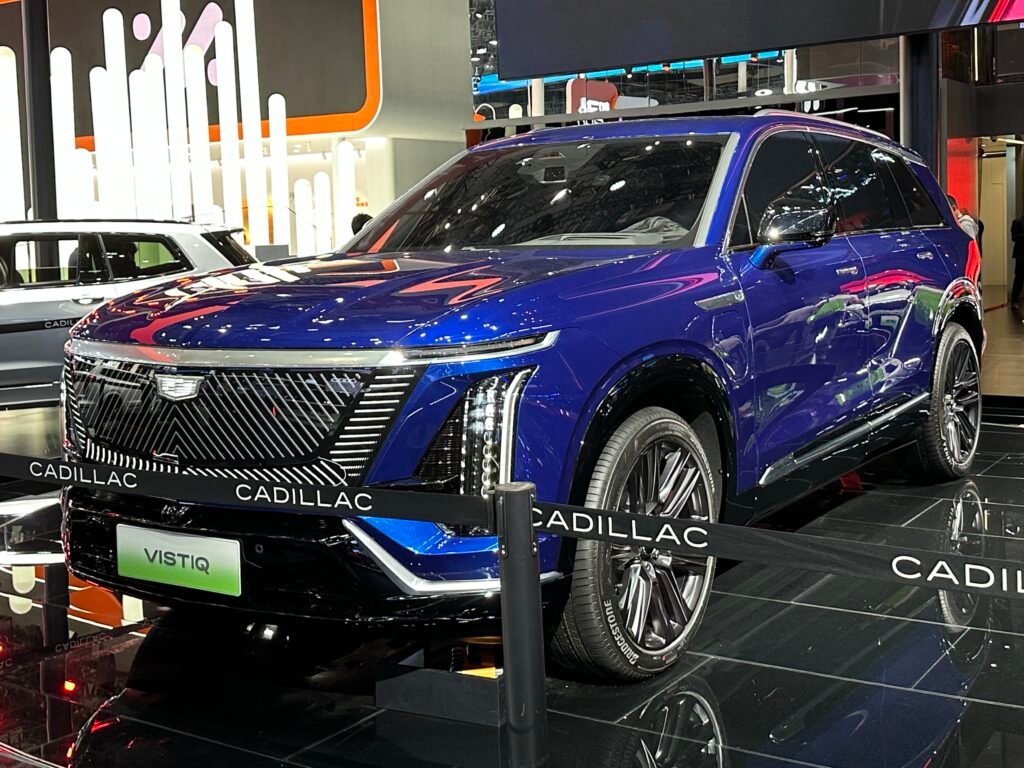
The VISTIQ’s third row is not an afterthought. Cadillac sells it as an adult-usable bench in a premium three-row electric SUV, and the power-folding mechanism that drops those seats flat is part of what lets a seven-seater open up into a large flat cargo floor on demand. That convenience is exactly what NHTSA campaign 26V394 is about.
The Feature Buyers Wanted Is the Feature Under Recall
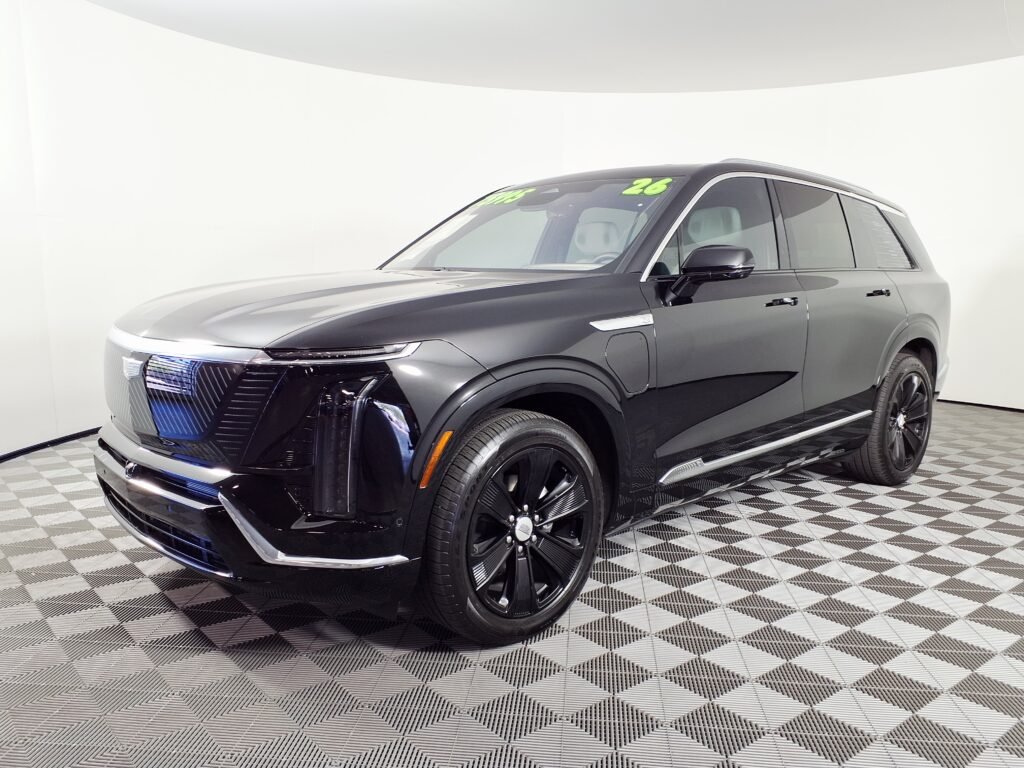
The 2026 Cadillac VISTIQ — the three-row electric SUV covered by recall 26V394. Photograph by HJUdall, released under CC0 1.0 (public domain) via Wikimedia Commons.
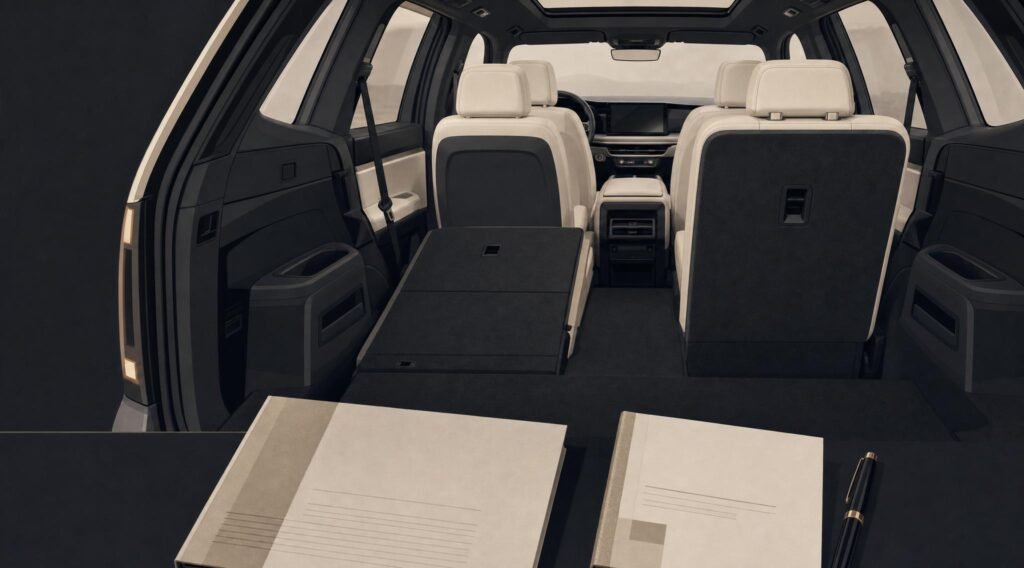
Cadillac lists the VISTIQ as a three-row electric SUV seating up to seven — six with second-row captain’s chairs. The cargo story is the relevant one here: Cadillac lists 15.2 cubic feet behind the third row, 43 with the third row folded, and 80.2 with both rear rows folded. Folding the third row is what unlocks the top of that range, and on these cars the third row folds at the touch of a button.
The VISTIQ’s power-folding third row is central to its passenger-and-cargo flexibility—and is the subject of U.S. recall 26V394. FSC editorial illustration; not a Cadillac, GM or NHTSA image.
That one-touch power-fold is the mechanism GM has now flagged as a safety defect. The feature that helps sell the VISTIQ as a do-everything family EV is the same feature the recall is written around — which is why the sensible response is to understand the fix, not to write off the vehicle.
What Recall 26V394 Actually Covers
Item
Detail
NHTSA campaign
26V394
GM recall number
N262555780
Vehicles affected (U.S.)
14,540
Models
2026–2027 Cadillac VISTIQ (battery-electric)
2026 production window
Nov 12, 2024 – Apr 9, 2026 (13,629 units)
2027 production window
Jan 16, 2026 – Jun 15, 2026 (911 units)
Estimated share of population with the defect
100%
Filed with NHTSA
June 18, 2026
NHTSA acknowledgement
July 1, 2026
Region
United States
A few boundaries matter. This is a U.S. campaign covering VISTIQs built inside those two production windows — not a statement about VISTIQ production worldwide. And while GM lists the defect as affecting an estimated 100% of that population, the figure describes the recalled build ranges, not every VISTIQ ever made. The recall was filed June 18 and acknowledged July 1; coverage that appeared later in the summer reflects media pickup, not a second, newer recall.
What the Third-Row Defect Actually Does
On affected cars, a single press-and-release of the “down” button — in the cargo area or on the pillar next to the seat — commands the third-row seatback to power-fold into the stowed position. Per GM, the seatback stops if it meets an obstruction but does not automatically reverse. GM’s stated risk is direct: a smaller occupant, especially a child, could become trapped under the seatback, increasing the risk of injury.
The chronology reads as a proactive filing rather than a crash-driven one. GM opened its review after another manufacturer’s March 2026 recall involving powered second- and third-row seats; a GM engineer then filed an internal Speak Up For Safety report on March 31, 2026, after an evaluation in which the seatback kept folding with a 33-to-40-pound box in the seat and stopped where the box could not be freed without manually reversing it. Its safety board decided on the recall June 11, 2026.
Two points deserve to be stated plainly, because coverage tends to blur them. First, GM lists one internal engineering evaluation and six additional incidents or complaints potentially related to the condition, and none resulted in injury — “no injuries” is not the same as “no incidents.” Second, the triggering event was another company’s recall, which GM does not name in its filing; there is no VISTIQ injury or fatality in these documents, and this article will not import one from elsewhere.
What the Recall Documents Say About Driving and Parking
Some recalls carry a formal “do not drive” or “park outside” advisory. This one does not: the Consumer Advisories section of GM’s Part 573 filing shows both the Do Not Drive and Park Outside boxes unchecked, and NHTSA’s public acknowledgement letter describes the hazard and the disable-then-replace remedy without either advisory.
This is not a blanket safety clearance. The identified risk remains when the third-row power-folding seatback is operated around a person or obstruction — it is tied to that folding motion, not to driving the vehicle or to where it is parked. Advisory status on an open recall can still change, so it is worth confirming the current status through NHTSA’s recall lookup before relying on it.
The Interim Disable Is Not the Permanent Repair
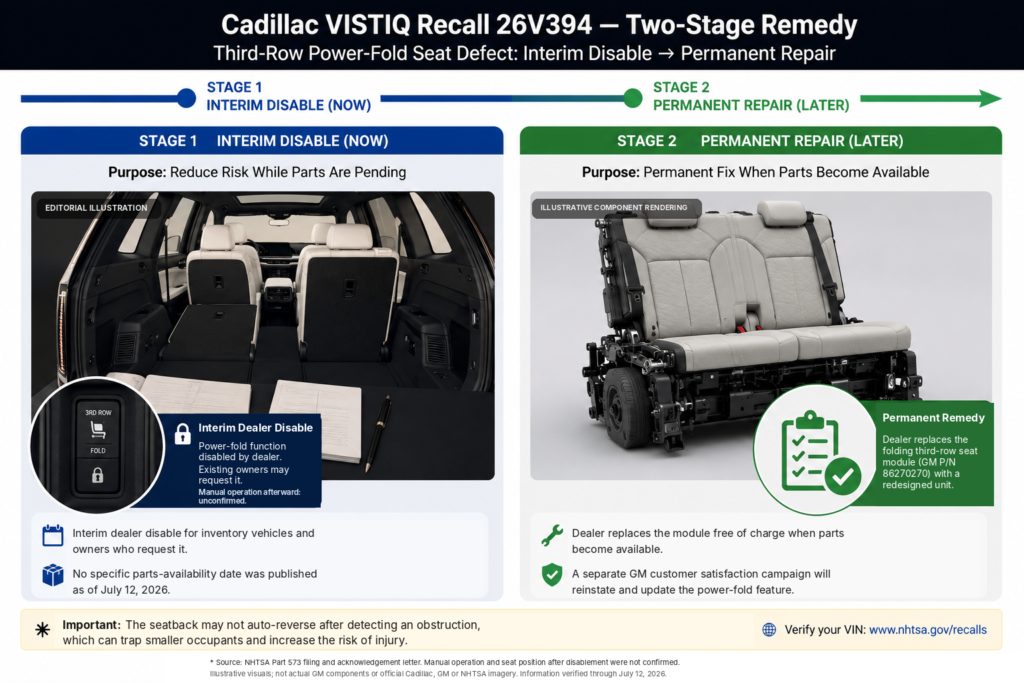
The most important thing to understand about 26V394 is that “getting the recall done” is not a single event. GM’s remedy runs in two stages.
Stage one is interim. Until replacement parts are available, GM’s filing says dealers may disable the third-row folding feature on vehicles in dealer inventory, and owners who want it done may have a dealer disable the feature on their own cars. For existing owners this reads as optional; for cars still on dealer lots, the handling is a dealer matter.
Stage two is the actual repair. Dealers replace the folding third-row seat module — supplied by Yanfeng, GM part number 86270270 — with a redesigned unit that automatically returns the seatback toward upright if a load stops it mid-fold. GM says the folding feature will then be reinstated and updated through a separate customer satisfaction campaign once parts are available.
GM’s filing describes an interim dealer disable while parts are pending, followed by replacement of the folding third-row seat module. Manual operation and seat position after disablement were not confirmed in the official documents reviewed. FSC infographic; illustrative, not official Cadillac, GM or NHTSA imagery.
Between those stages sits the part buyers should press on. As of the June 18 filing and the July 1 acknowledgement, GM had not announced when replacement parts would be available — which is not the same as “unavailable indefinitely,” but does mean there is no published date to plan around. And what the interim disable leaves behind functionally is not established in the documents available for this article: the dealer bulletin that would spell out whether the third row can still be folded by hand after the power-fold is disabled, and what position it holds, could not be reviewed. So the usability question — can you still drop the third row for cargo during the interim period, or is it effectively fixed until the new module arrives? — is one to settle with the dealer in writing, not to assume in either direction.
Post-Purchase Risk Map
Risk area
Where it stands
Safety exposure
Real when powering the third row down with a small occupant present; no driving or parking advisory in the reviewed documents
Third-row power-fold
Can be disabled as an interim measure while parts are pending
Post-disable usability
Unconfirmed — whether the third row still folds manually after the disable is not established; verify with the dealer
Parts timing
No replacement-parts availability date announced as of the filing and acknowledgement
Extra dealer visit
Completion is likely staged: an interim step now, a module replacement later
VIN and documentation
VINs searchable on NHTSA.gov since June 18, 2026; keep every repair order
Pending-order / inventory exposure
2027 shipments were paused June 8, 2026; confirm delivery timing and remedy sequence by VIN
Early used exposure
Some cars may be unrepaired or interim-only; confirm status and get repairs in writing
Until the fix is done, keep children and objects clear of the third-row seatback’s path when using the power-fold. The hazard is specific to that folding motion.
Ask your dealer what interim action applies to your car, and whether the disable makes sense for how you actually use the third row.
Get the post-disable functionality in writing — specifically whether the third row can still be folded manually, and what position it holds — so you are not guessing during the interim period.
Keep the paperwork for both stages: the interim disable and, later, the module replacement.
None of this involves doing anything to the seat yourself. The disable and the replacement are dealer procedures.
What New and Used Buyers Should Require
The recall applies to a car whether it is sold new, from inventory, or used, so the burden is the same across the board: documentation, not reassurance.
Pending order. Confirm your VIN’s recall status before delivery, and ask two questions in writing — will the car arrive with the third-row feature disabled, and will the module replacement happen before delivery or be scheduled after? Because 2027 shipments were paused on June 8, 2026, timing can move, and “it’ll be handled” is not something you can hold anyone to later.
Dealer inventory. Ask for written proof of the car’s recall status, whether the interim disable has been performed, and the plan for the permanent module. If flexible third-row seating is central to why you want the VISTIQ and the remedy timeline is vague, that is a legitimate reason to cross-shop while you wait.
Early used. A VIN lookup is not optional here. Get written confirmation of any interim disable or completed repair, plus the plan for the permanent module, before money changes hands. Do not assume that a certified-pre-owned label proves the recall is complete — CPO status and recall completion are separate things, and only the VIN record and the repair order settle it.
Buyer Decision Grid
Cohort
Call
Why
Verify first
Owner, children in third row
ACT
Entrapment risk maps directly onto how the car is used
VIN status; whether the interim disable is advised
Owner, light third-row use
KEEP / ACT
Lower exposure, but the recall still needs completing
VIN status; how you’ll be told when parts are ready
Owner weighing the disable
RECHECK BEFORE DECISION
Safety-vs-flexibility trade-off turns on unconfirmed seat behavior
Post-disable third-row function; free reinstatement later
Pending-order buyer
RECHECK BEFORE DELIVERY / WAIT
Shipment pause and no parts date make timing uncertain
VIN status; disable/replacement sequence before delivery
Dealer-inventory buyer
RECHECK BEFORE DELIVERY / CROSS-SHOP
Inventory handling and saleability rules aren’t documented here
Written recall status; interim disable performed or not
Early used buyer
RECHECK BEFORE PURCHASE / CROSS-SHOP
Risk of an unrepaired or interim-only car
VIN status; written proof of any repair
Frequent seven-seat ↔ cargo swapper
WAIT / CROSS-SHOP
Interim third-row flexibility is exactly what’s unconfirmed
Whether the third row still folds by hand during the interim
This is deliberately not a model-wide “buy” or “skip.” The VISTIQ’s underlying case as a three-row luxury EV is not what 26V394 decides; what it decides is how carefully you verify a specific car’s status before you rely on it.
Straight answers
Frequently asked questions
Is the VISTIQ under a do-not-drive order?
No. GM’s Part 573 filing shows both the Do Not Drive and Park Outside boxes unchecked, and the risk is tied to operating the third-row power-fold with someone in the way, not to driving or parking the car. This is not a blanket all-clear — confirm the current status through NHTSA’s recall lookup, since advisory status on an open recall can change.
Is the permanent repair available yet?
Not as of GM’s June 18 filing and NHTSA’s July 1 acknowledgement — GM had not announced a parts-availability date. The interim disable is a temporary safety step, not the completed repair; completion means the replacement module is installed.
What should a pending-order buyer confirm?
The VIN’s recall status before delivery, whether the car will arrive with the feature disabled, and whether the module replacement is scheduled before or after delivery.
Does a clear VIN lookup prove the permanent repair was done?
Not by itself. NHTSA says its VIN tool does not display safety recalls that have already been repaired or manufacturer service campaigns. Ask for the repair order and confirm whether the replacement seat module was installed.
The dealer interim service bulletin for this campaign was not accessible for this article; details that depend on it are flagged as unconfirmed above.
Limitations
This article covers the U.S. NHTSA campaign only and does not establish coverage in Canada, Europe, or other markets. FSC has not inspected, driven, or tested a VISTIQ; this analysis is based on the NHTSA recall filing, NHTSA’s acknowledgement letter, and Cadillac’s official published figures. The dealer interim bulletin was not available, so the exact post-disable third-row seat position and whether the seat can still be folded manually are unconfirmed. GM’s Part 573 filing shows no do-not-drive or park-outside advisory (both boxes unchecked), though advisory status on an open recall can still change — confirm the current status through NHTSA’s recall lookup before relying on it. There is no current evidence on resale, insurance, or depreciation effects tied to this recall, and none is asserted. Information is current as of the date below.