14 July 2026
BMW Certified EV 75% SoH Warranty: What Buyers Must Verify
EVs & Charging
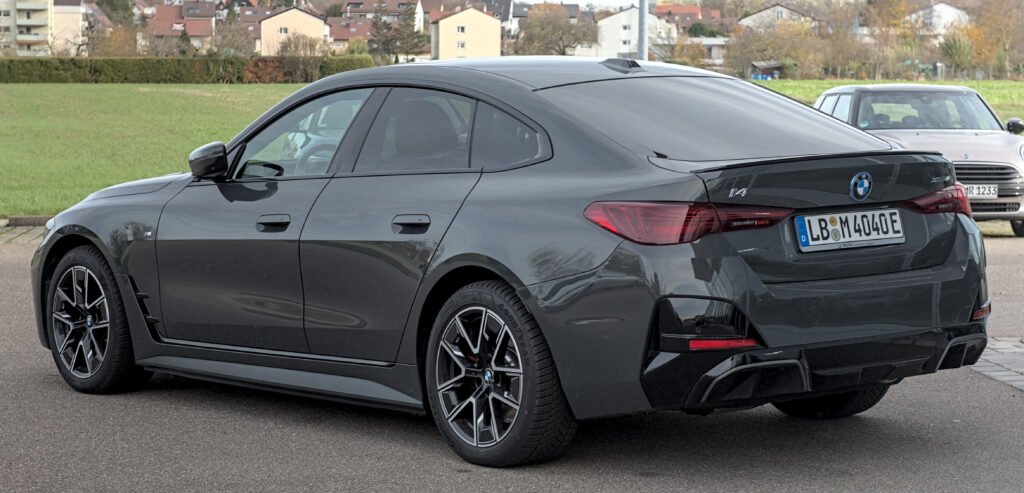
BMW USA describes separate capacity-loss coverage for eligible 2022–2025 Certified EVs when battery State of Health falls below 75%. Its public pages don’t line up on who qualifies — and the document that would settle it isn’t among them.
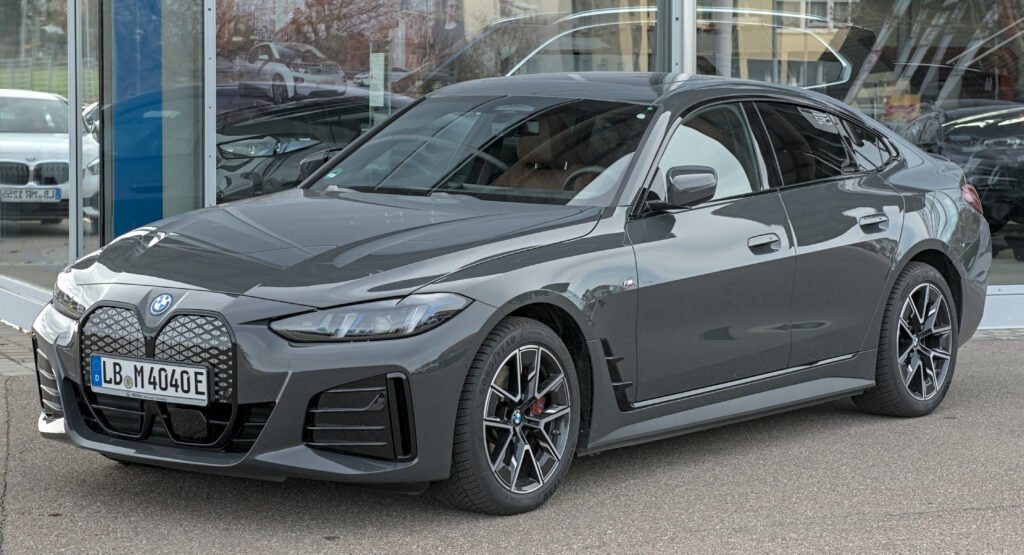
must be confirmed for the specific VIN and transaction.
A used BMW listed as Certified now carries a reassuring-looking line: the battery’s State of Health is protected at 75%. It reads like a floor. Whether it actually protects the specific car in front of you — and for how long — is the part BMW’s public pages don’t finish answering.
BMW USA describes a separate capacity-loss warranty for eligible 2022–2025 BMW Certified all-electric vehicles, triggered when battery State of Health drops below 75%, running eight years or 100,000 miles from the vehicle’s original in-service date. The headline is simple; the eligibility isn’t. BMW’s principal Certified pages tie the coverage to a “Retail Delivery” date on or after March 1, 2026, while a shorter warranty-information page omits that boundary. And the clock runs from the car’s original in-service date, not from the later Certified purchase. FSC could not locate a public controlling document that resolves the date definition, the SoH measurement, the remedy, or the transfer rules. Before assigning value to the 75% warranty, a buyer needs three things in writing: VIN-specific eligibility, the time and mileage actually left, and the battery-health record. The starting call: recheck before purchase.
A Certified sale doesn’t restart the battery clock
BMW’s public wording starts the capacity-loss clock at the vehicle’s original in-service date. It does not start a new eight-year term at the later Certified purchase, so a second owner inherits whatever time and mileage remain.
That changes what the warranty is worth. Take a hypothetical, with invented figures: a Certified EV first placed in service in April 2022, bought used in June 2026 with 45,000 miles. By BMW’s wording the clock still ends on the original schedule — roughly April 2030, or at 100,000 total miles, whichever comes first. That leaves under four years and about 55,000 miles of coverage, not eight years from the day of purchase.
Why the March 1, 2026 line needs written confirmation
Here the public pages stop matching each other. BMW’s Certified all-electric page and its main Certified page both describe the capacity warranty for 2022–2025 Certified EVs “with Retail Delivery dates March 1, 2026 and beyond.” The shorter Certified warranty-information page describes the same coverage for “all 2022–2025 BMW Certified EV models,” with no delivery-date condition.
All three are current BMW USA pages, none is the governing document, and none defines “Retail Delivery” — it could mean the Certified sale, the handover to the customer, the original new-car delivery, or an internal reporting date. The omission matters for any car whose relevant “Retail Delivery” date falls before March 1, 2026. Because the pages neither define the term nor say which summary controls, the VIN-specific answer is one to confirm with BMW or the selling center in writing.
Three coverage layers, and only one is about capacity
Some of the confusion comes from bundling three separate coverages together when only one is about battery capacity. They begin on different dates, cover different failures, and — on the public documents — transfer under different rules.
| Coverage layer | Publicly described purpose | Clock or trigger | What the buyer still needs to verify |
|---|---|---|---|
| BMW Certified Pre-Owned Limited Warranty | One year of unlimited-mile coverage after the 4-year/50,000-mile new-vehicle warranty. Separate from SoH capacity coverage. | No SoH trigger; BMW publishes a transfer application for this warranty | Applicable exclusions, and how this layer interacts with the high-voltage battery warranties |
| High-Voltage Battery Limited Defect Warranty | Defects in materials or workmanship in the high-voltage battery assembly | 8 years/100,000 miles from vehicle in-service date; no capacity threshold stated | Detailed exclusions, and transfer beyond the Certified buyer |
| High-Voltage Battery Limited Capacity Loss / SoH Warranty | Capacity loss for eligible 2022–2025 Certified EVs when SoH drops below 75% | 8 years/100,000 miles from original in-service date; public pages differ on the March 1, 2026 boundary | “Retail Delivery” definition, exact measurement and rounding, remedy, transfer, and complete model eligibility |
The general Certified Limited Warranty has a documented transfer process — a $200 fee, a notarized statement, a 60-day window, private party to private party, dealers excluded — but that process is written for the Certified Limited Warranty, and BMW’s pages don’t extend it to the capacity/SoH coverage. BMW does say the remaining term of the battery defect warranty passes to the Certified buyer; it doesn’t say the same about the capacity warranty.
The battery certificate and the Quick Report aren’t defined as the same thing
BMW’s Certified EV page names two things a buyer might take to be the same document. It says a Certified EV buyer receives an “up-to-date battery certificate.” Separately, it describes a “Battery Health Quick Report” run on every Certified pre-owned vehicle to establish the battery’s State of Health.
What the page doesn’t explain is how those connect — whether the certificate is the Quick Report, is drawn from it, or is a separate record — or whether the buyer receives a copy showing a numerical SoH, how it’s measured, or how long it stays valid. For a warranty built entirely around a percentage, the sensible step is to ask for both records in writing, and for BMW’s own account of how they relate.
Where the public wording runs out
A few questions that decide the warranty’s value simply aren’t answered publicly.
The threshold is stated two ways: BMW’s detailed text uses “drops below 75%,” while a nearby explainer says the battery is “protected once it hits 75%.” Whether an exact reading of 75.0% qualifies, and how BMW rounds or tolerances the measurement, isn’t published.
The 75% is a claim trigger, not a promise about the specific car for sale. BMW’s stated Certified criteria — roughly five model-years old, under 60,000 miles, with history and inspection checks — don’t include a minimum State of Health, and the 2023 Certified inspection checklist BMW publishes doesn’t measure SoH at all; it checks charging and State of Charge and points technicians to a separate operations manual for the full rules. Nothing public establishes a required State of Health at sale, and nothing public rules out an internal standard either.
The remedy is described only in general terms — for a covered battery, an authorized center will “diagnose, update software, and repair or replace the necessary high-voltage battery components at no cost.” That language is component-level; it doesn’t promise a new, complete pack for a below-75% claim, or state what State of Health the car is restored to.
And the comparison BMW leans on — that its 75% beats a “70% industry standard” — is BMW’s own claim, made without citing an independent source.
What to get in writing before a deposit
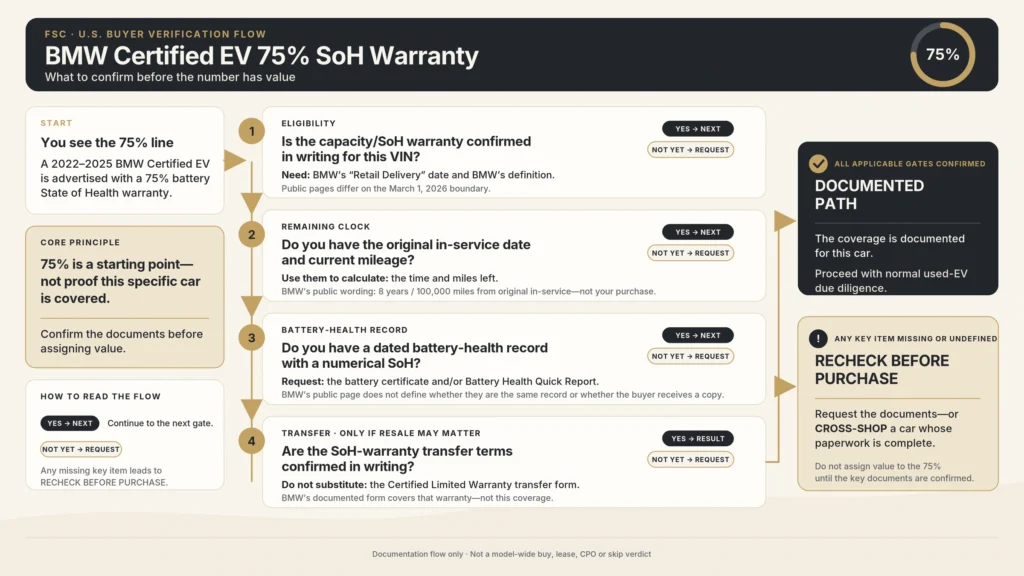
Every open point above is something a seller can put in writing, and a careful buyer should ask before committing. Before leaving a deposit, ask for:
- written confirmation that the capacity/SoH warranty applies to this specific VIN;
- the “Retail Delivery” date BMW is using for the car, and how BMW defines it;
- the original in-service date and current mileage, to work out the time and miles left;
- the battery certificate and the Battery Health Quick Report — and whether one comes from the other;
- the test date and the numerical State of Health, if the record shows one;
- the applicable warranty booklet or addendum, if the dealer can produce it;
- the written claim and remedy process, and whether the coverage transfers on resale.
These are buyer requests, not published disclosure entitlements. A seller’s inability to produce them doesn’t prove the warranty is invalid — but it does leave the buyer unable to assign reliable value to the 75% coverage, which is reason enough to confirm the details in writing, or to cross-shop a car whose paperwork is complete.
Frequently asked questions
Does 75% State of Health mean 75% of the car’s original EPA range?
No. BMW describes State of Health as the battery’s current maximum energy capacity compared with its original capacity. Real-world range also depends on the vehicle, driving conditions, and terrain, so the two figures aren’t interchangeable.
What happens if the battery measures exactly 75.0%?
BMW’s public copy uses both “protected once it hits 75%” and “drops below 75%,” and FSC could not locate published rounding or tolerance rules. An exact 75.0% reading shouldn’t be assumed to qualify — it’s a point to confirm with BMW in writing.
Does the capacity-loss / State of Health warranty transfer to a later owner?
FSC could not locate public transfer rules specific to this coverage. BMW’s separate Certified Limited Warranty transfer application shouldn’t be assumed to govern it, so a buyer planning to resell should confirm the transfer terms in writing.
Sources checked
- BMW USA — Certified Pre-Owned all-electric: capacity/SoH warranty wording, the March 1, 2026 Retail Delivery boundary, the Battery Health Quick Report, the battery certificate. Accessed July 13, 2026.
- BMW USA — Certified Pre-Owned warranty information: SoH warranty summary without the delivery-date boundary. Accessed July 13, 2026.
- BMW USA — Certified Pre-Owned (main): Certified Limited Warranty structure; carries the March 1, 2026 boundary. Accessed July 13, 2026.
- BMW USA — Certified Limited Warranty Transfer Application (PDF): Certified Limited Warranty transfer terms. Accessed July 13, 2026.
- BMW USA — Certified inspection checklist, 2023 (PDF): CPO inspection scope; no SoH measurement. Accessed July 13, 2026.
- BMW USA — Certified “What Is Not Covered” (PDF): Certified Limited Warranty exclusions. Accessed July 13, 2026.
Limitations
FSC has not inspected a vehicle or reviewed any VIN-specific warranty record. This article is based on public BMW USA program and marketing pages checked on July 13, 2026, not on a signed warranty contract; FSC could not locate a public controlling document for the capacity/State of Health warranty. Terms, eligibility dates, and figures can change without notice — confirm current wording with BMW of North America or a dealer before relying on any point here.